
Data storytelling vs data visualisation: what's the difference?

Updated: May 7
The two terms get used interchangeably, but they describe two different things. Understanding the distinction is one of the most practically useful things a data team can do, because confusing them leads to work that looks good but doesn't get used.
The simplest way to put it: data visualisation presents data visually. A visualisation may or may not tell a story. Data storytelling communicates a data-derived message. A data story may or may not include visuals.
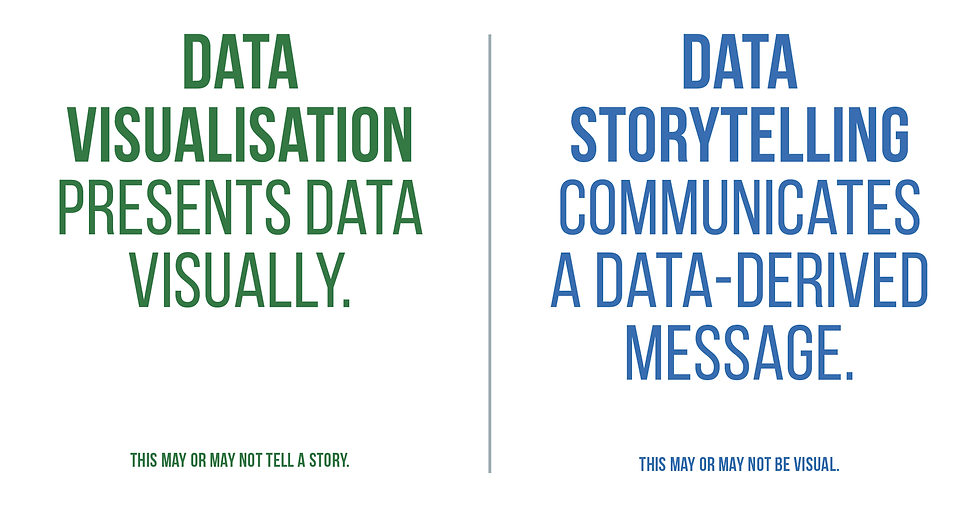
That second part tends to surprise people. But stories are about structure and meaning, and those can be communicated verbally, in writing, in a slide, or in a chart. The medium is secondary. The message is what's important.
Three reasons to visualise data (and only one of them is storytelling)
Most data teams visualise data for multiple reasons, often without realising they're doing different things each time. In The Data Storyteller's Handbook, these reasons are organised into three categories: Discover, Inform, and Educate.
Discover visuals are created during the analysis process. They help analysts find patterns and understand what's happening in the data. They're not designed to be shared because they're an analytics tool. What's clear to the person who built them is rarely clear to anyone else, because the context lives in the analyst's head rather than on the screen.
Inform visuals are for audiences who already understand the subject. A dashboard is the classic example. It surfaces key metrics for people who know what to look for, without needing to explain what any of it means. Inform visuals present data clearly, but they don't explain what the data means. That fine when your audience is expert, but a problem when they aren't.
Educate visuals are where data storytelling lives. These are built for audiences who need context to understand the data's significance and act on it. They don't just show the numbers like Inform visuals, they explain what the numbers mean. Designing an Educate visual requires understanding the story first. The visual serves the narrative, not the other way around.
The biggest distinction between Inform and Educate is whether a story is present. A visual designed for communication without narrative is an Inform one. Add narrative, audience context, and a possible call to action, and you're in data storytelling territory.
The mistake most teams make
The most common problem is treating Inform visuals as if they're doing the job of Educate visuals. A dashboard goes out to senior leaders who aren't close to the data. A chart gets shared in a meeting without explanation. Analysis is presented as if the insights are self-evident.
They rarely are. An audience that doesn't already understand the data needs context, framing, and a clear message before a visual can be useful to them. Without that, even a well-designed chart gets ignored or misread.
The skills required for each type of visual are genuinely different. Building a good dashboard requires technical knowledge and an understanding of how subject experts use data. Telling a good data story requires understanding your audience, identifying what decision you're trying to support, and structuring a narrative that takes people from insight to action. These are communication skills, and most data teams haven't been trained in them.

Why the distinction matters for your team
Knowing which type of visual a situation calls for changes what you build and how long you spend on it. A Discover visual can be rough because it's a thinking tool, and aesthetics are irrelevant. An Inform visual needs to be clean and legible for an expert audience. An Educate visual needs a story behind it, or it won't work regardless of how polished it looks.
Many teams put significant effort into visualisations that are technically Inform tools, and then wonder why senior stakeholders aren't engaging with them. The answer is usually that those stakeholders needed an Educate approach: they needed the story, not just the data.
Recognising which mode you're working in—and designing accordingly—is one of the highest-leverage shifts a data team can make.
Go deeper
The Data Storyteller's Handbook covers the Discover, Inform, and Educate framework in detail, including how the three types of visuals work together within an organisation's data communication practice.
If your team is ready to develop these skills directly, the Rogue Penguin workshop is designed for exactly this: helping data professionals move from just presenting information to communicating it effectively.
Kat Greenbrook is a data storytelling consultant, author, and workshop facilitator based in Wellington, New Zealand. She is the founder of Rogue Penguin and the author of The Data Storyteller's Handbook.
